
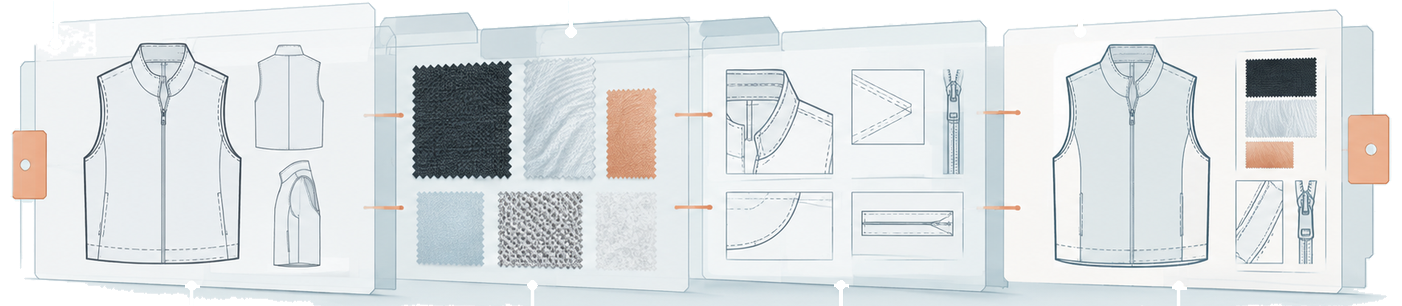
Working with several manufacturing partners can expand a fashion brand’s capacity and capabilities, but it also multiplies the places where specifications, approvals, and production updates can become disconnected. The operating challenge is not simply choosing capable suppliers. It is giving every partner access to the right product information, revision, milestone, and quality expectations while keeping ownership clear.
Brands and designers can explore iCreate Pro
for organizing tech packs, fashion projects, and controlled product information.
For teams researching “managing multiple manufacturers fashion brand,” the practical starting point is one controlled source for tech packs, BOMs, revisions, approvals, and milestone status. This creates shared visibility without removing the specialist knowledge each manufacturing partner brings to production.
The reasons for using multiple partners vary by collection, capability, geography, and capacity. Understanding those trade-offs is the first step toward building a coordinated model that protects both production continuity and brand consistency.
Why would a fashion brand work with multiple manufacturers?
Working with several manufacturers can help a fashion brand match each product, order, and market requirement with the right production partner. One supplier may have strong knitwear expertise, while another is better suited to outerwear, finishing, smaller runs, or a particular material. A multi-manufacturer model also gives a brand more options when capacity changes, delivery routes become impractical, or production needs to be closer to a target market.
Build a supplier portfolio, not a collection of disconnected vendors
The goal is not to spread every style across as many factories as possible. It is to build a deliberate supplier portfolio. Brands can assign work according to capability, available capacity, geography, lead-time requirements, and the level of collaboration a product needs. This approach can also improve resilience. When one partner cannot take on a development or production request, the brand has an established alternative rather than starting supplier selection from zero.
Seasonal relationships are often neither permanent nor one-off. Research on agile supply partnerships in fashion footwear describes them as recurring and intermittent, with companies selecting from relationships that fit the needs of a particular season. Read the research on recurring fashion supply partnerships. That means a supplier’s value is not limited to machine capacity. Its product knowledge, responsiveness, and willingness to share production insight can matter when a collection is being developed under time pressure.
For a fashion brand managing multiple manufacturers, a clear operating model is as important as the supplier relationships. Each partner needs the right specifications, responsibilities, approvals, and milestone information. Without that shared visibility, the advantages of a broader supplier network can quickly become duplicated work, conflicting revisions, and uncertain status. The next step is understanding where production information becomes difficult to control when it is split across partners.
What gets harder when production is split across manufacturers?
Working with several manufacturers can expand a brand’s options, but it also spreads important decisions across people, systems, and time zones. The difficulty is not only knowing which supplier has a task. It is knowing who owns the latest decision, whether a change has reached every relevant partner, and which milestone reflects the current plan.
Visibility breaks down when ownership is unclear
Suppose a fit comment is agreed in a call, a revised design file is sent by email, and a production status remains in a spreadsheet. Each record may be accurate when created, yet the team still lacks one dependable view of the product. This is the version-control fragmentation that fashion brands identify across spreadsheets, design files, documents, and email. And it becomes especially difficult when multiple manufacturers are working from related but not identical information.
A practical control is to assign an owner to each product record, revision, approval, and milestone. The record should show what changed, when it changed, who approved it, and which supplier is expected to act. That makes timing issues easier to spot before a missed handoff becomes a production delay. It also separates a supplier’s current status from an outdated update copied into a separate message.
Quality signals need the same discipline. Sample comments, tolerance concerns, inspection observations, and open exceptions should be attached to the relevant product or production stage, rather than left in an inbox. Brands looking to control shared product information can use a connected record as the reference point for communication, while still giving each manufacturer access only to the information needed for its work.
How can a brand build one source of truth for production information?
Start with a shared product record for every style, rather than treating email threads, spreadsheets, and local design files as separate working systems. Each record should give the team a common operational picture while the brand retains ownership of the information that defines the product.
- Product identity: Record the style, collection, season, colorway, and intended manufacturer.
- Current stage: Show whether the style is in development, factory review, sampling, approval, or production.
- Decision ownership: Name the person responsible for the next decision and the partner expected to act.
- Evidence: Keep the approved specification, revision history, milestone status, and open exceptions with the record.
Define the record before inviting partners
Use a consistent naming convention for styles, colorways, sizes, and revisions. A practical identifier might combine the collection, style number, color code, and revision number. Apply it to the tech pack, bill of materials, sample comments, approvals, and production correspondence. The specific format matters less than using it every time.
Separate durable product data from temporary discussion. The record should hold the approved design assets, construction details, supplier fields, measurements, tolerances, and current BOM. Meeting notes and open questions can sit alongside it, but they should not become an unofficial replacement for the approved specification.
Access rules are equally important. Give each internal role and manufacturing partner access to the information needed for its work. Assign one brand-side owner for product information and one accountable contact for each factory. That prevents a revision from being approved by several people without a clear decision owner. When a partner no longer needs access, remove or revoke it rather than leaving old files available indefinitely.
The iCreate Pro platform supports creating, storing, organizing, and sharing tech packs and fashion projects, with controls for managing access and revoking it. For brands seeking to control shared product information, this type of central record can provide a defined home for the latest approved version.
Finally, make status explicit. Use states such as draft, internal review, factory review, sample revision, approved for production, and superseded.
- Record the decision date, approver, and reason for each material change.
- Assign every exception to a named owner with a due date and resolution note.
- Define change rights so the record states who may propose, review, approve, or supersede information.
The source of truth is not just a file repository. It is a shared agreement about which information is current, who may change it, and how unresolved issues move toward a decision.
How should brands control specifications and revisions across factories?
When several factories work from the same collection, specification control should not depend on which file is attached to the latest email. Give every partner a consistent product record, a named approval owner, and a visible history of what changed and why. That creates a common reference point while allowing each factory to work within its assigned scope.
Build one controlled specification for each style
Start with a tech pack that brings the product definition together. iCreate describes smart tech packs as human- and machine-readable, with fields that support factory production. The record can include flat sketches with callouts, multiple views, seam, stitch, and finish details, colorways, and supplier information. Keep the bill of materials connected to the style rather than treating it as a separate spreadsheet. A process for maintaining accurate garment specifications makes it easier to see which materials, components, and suppliers belong to each version.
Define tolerances and points of measure in the same working record. A measurement that is acceptable for one construction detail may not be acceptable for another. So write the tolerance beside the relevant measurement instead of leaving interpretation to a factory team. Include the required sample stage, review status, and the person responsible for approval. These details reduce ambiguity when the same style moves between development, sampling, and production partners.
Make every revision traceable and permissioned
Assign ownership before a change is requested. The brand may own the design intent, while a technical lead confirms construction changes and a designated production owner coordinates the factory response. Factories should be able to access the information needed for their work, but access should not silently grant permission to alter the master specification. Use clear roles for viewing, proposing, reviewing, and approving changes.
Every approved revision should carry a version identifier, date, reason for change, affected components, and approval record. Notify all factories whose work depends on the change, then close or supersede the previous version so it cannot be mistaken for the current one. A shared change log also gives the brand a practical audit trail: teams can distinguish an approved update from a local workaround, open question, or unconfirmed request. This is especially important when different partners are sampling, sourcing materials, and preparing production at the same time.
Worked example: one approved revision, two factory handoffs
Consider a hypothetical outerwear style being sampled by Factory A while Factory B prepares a second production option. During fit review, the brand changes the sleeve opening and replaces one trim component. The change is useful only if both partners can identify the same approved direction.
- Create the revision: The brand records the change as revision 03, links the affected sleeve measurement and trim line in the BOM, and states why the update was made.
- Route the approval: The technical owner reviews the construction impact, and the brand approver records the effective date. Factory A’s sample comments and Factory B’s production preparation remain linked to the affected style.
- Close the old version: Revision 02 is marked superseded. It remains available for traceability but is no longer presented as the active production instruction.
- Confirm the handoff: Each factory acknowledges revision 03 and records its next action. Factory A updates the next sample, while Factory B confirms whether the trim change affects sourcing or timing.
If Factory B flags a supply issue, the team can log an exception against revision 03 instead of silently editing a local copy. The exception record can identify the partner, affected component, decision owner, corrective action, and recheck date. The operational benefit of this example is traceability: the brand can see which instruction is active, which partner is affected, and where a decision remains open. This is a process example, not a claim about a specific iCreate customer outcome.
How can brands coordinate milestones and quality across manufacturing partners?
Multiple partners need more than a shared deadline. They need the same definition of readiness, the same approval record, and a visible route for resolving exceptions. A milestone should show what has been completed, what evidence supports it, who owns the next decision, and which partner is responsible for the handoff.
Keep the workflow consistent across factories while allowing each partner to document its own production details. This makes comparisons more useful and prevents a missed approval from becoming a late discovery during bulk production.
A repeatable milestone sequence
- Intake: Create the project record with the style, partner, responsible contacts, required specifications, planned quantities, and key dates. Confirm that each manufacturer is working from the same approved product information rather than an isolated email attachment.
- Sampling: Record the sample request, supplied materials, construction notes, measurements, and open questions. Ask the partner to flag any point that cannot be produced as specified before the sample is treated as representative.
- Approval: Assign one brand-side approver and capture the accepted sample, comments, revision, and approval date. If changes are requested, close the previous version clearly so another partner cannot continue against superseded instructions.
- Production: Move the style into production only after the required approvals are visible. Track each partner’s status against the same milestone names, while retaining partner-specific notes for materials, capacity, or process constraints.
- Inspection: Define the checks that matter for the product, such as measurements, construction, finish, color, labeling, or packaging. Attach inspection findings to the relevant style and lot, and distinguish an observation from an accepted deviation.
- Exception handling: Log the issue, affected partner and product, decision owner, corrective action, and recheck date. Do not quietly revise the specification to fit one factory. Escalate the exception for a documented brand decision, then update the shared record so all affected partners see the current direction.
Manufacturers and factory teams evaluating ways to coordinate factory management workflows can apply the same principle: make the milestone record the working reference, not a private spreadsheet. iCreate Core is designed to connect manufacturers and professional designers while tracking project details.
How do brands maintain consistency across manufacturing partners?
Consistency begins before production starts. A brand should define the decisions that cannot vary between partners, then give each factory enough operating detail to execute those decisions without guessing. This includes the approved design, materials, construction details, color standards, measurement tolerances, labeling, packaging, and the point at which a change requires brand approval.
It also helps to separate shared standards from partner-specific methods. Factories may use different equipment or sequence work differently, but the required product result and the evidence used to approve it should remain comparable. A pre-qualified supplier network can help brands select partners with known capabilities and operating performance for each season, rather than treating every allocation as a fresh experiment. This portfolio approach is especially useful when partnerships recur intermittently, as described in research on agile fashion supply partnerships (supplier network research).
Controls that support consistent execution across manufacturing partners.
Scroll horizontally to read the full table.
| Control area. | Shared standard. | Evidence to review. |
|---|---|---|
| Brand and product requirements. | One approved design, tech pack, BOM, colorway, construction description, and tolerance set. | Current revision, approval owner, and acknowledgement from each partner. |
| Decision rights. | Named owners for design, materials, fit, quality, and production changes. | Decision log showing request, disposition, approver, and effective date. |
| Sample review. | Common review criteria for fit, workmanship, measurements, color, and finish. | Annotated sample records, test results where relevant, and approval status. |
| Supplier communication. | Defined channel, response expectations, milestone language, and escalation route. | Meeting notes, open issues, owner, due date, and resolution history. |
| Feedback loops. | Lessons from inspections, returns, and production exceptions fed into future briefs. | Corrective actions, recurring issue reviews, and updated standards. |
Reviewing evidence matters as much as publishing the standard. A shared document that no one acknowledges is not operational control. The brand should schedule sample gates and production checkpoints, compare findings against the same criteria, and record exceptions rather than relying on informal messages. A practical quality management process can help align manufacturing quality standards while leaving room for each partner’s approved capabilities.
Finally, feedback should move in both directions. Brands need to communicate decisions clearly, while suppliers should be able to flag an impractical specification, material risk, or timing conflict before production advances. That exchange protects the intent of the collection without forcing every partner into identical methods.
What technology helps with managing multiple manufacturers in a fashion brand?
Connected technology helps a brand replace isolated handoffs with a shared operating view. The goal is not to put every manufacturing activity into one generic tool. It is to connect the information, people, and workflows that need to stay aligned while preserving appropriate access for designers, suppliers, manufacturers, and factory teams.
Think in connected layers, not one oversized system
- Shared product information: A brand needs a controlled place for tech packs, design files, bills of materials, supplier details, revisions, and approval status. iCreate Pro supports creating, storing, organizing, and sharing tech packs and fashion projects, with controls that allow users to manage access to designs and revoke it when needed. That gives designers and brand teams a clearer foundation for sending the right information to each partner.
- Collaboration and project tracking: Multiple manufacturers may work on different products, stages, or seasons, so communication needs more structure than an email chain. iCreate Core is designed to connect manufacturers and professional designers and track project details. This type of collaboration layer can help teams clarify responsibilities, record progress, and surface exceptions without treating every partner as if it has the same role.
- Factory operations: Production teams may need workflows for plant-level activity, inventory, warehousing, and rapid response. iCreate Power is positioned for those factory operations. Pro serves designers and brands, while Core supports manufacturer-to-designer collaboration. Keeping these boundaries clear matters when managing multiple manufacturers in a fashion brand: a shared platform should connect work without hiding the operational needs of each participant.
This connected model is consistent with the broader direction of manufacturing technology. The NIST publication Roadmap to Strengthen the U.S. Manufacturing Supply Chain via Digital Thread Technology (NIST GCR 24-057, published in 2024) describes digital thread technology as a way to connect information across stages of an extended manufacturing supply chain. That is sourced context, not a claim that iCreate or any other platform automatically creates a digital thread.
iCreate.Fashion describes its ecosystem as connecting designers, suppliers, manufacturers, retailers, consumers, and financial institutions. For a brand coordinating several partners, that wider perspective can support improved supply chain transparency by keeping relevant information connected across the product journey.
Fashion brands can explore iCreate Pro for a more structured way to organize product information, manage fashion projects, and share the right approved details with manufacturing partners.
Frequently Asked Questions
How can a fashion brand manage multiple manufacturers?
Use one shared operating structure for every partner. Define ownership for each style, assign clear production milestones, and keep approved specifications, decisions, and status updates in a controlled workspace. This gives the brand one current view of work while allowing each manufacturer to manage its assigned activities.
How can a fashion brand keep product specifications consistent across multiple manufacturers?
Maintain a single approved tech pack and BOM for each product, with clear revision ownership and access to the current version. Record changes formally, communicate effective dates, and use the same terminology for measurements, materials, tolerances, and construction details across every manufacturing partner.
How can a fashion brand track production across multiple manufacturing partners?
Track shared milestones rather than relying on separate email threads or spreadsheets. For each order or style, record the responsible partner, current stage, expected next action, dependencies, and exceptions. A consolidated view makes it easier to identify stalled work and follow up with the right team.
How do you maintain quality control across multiple clothing manufacturers?
Apply the same quality criteria and review points to every partner. Define inspection requirements against the approved specifications, document findings with the relevant style and revision, and assign corrective actions with owners and due dates. Consistent records help teams compare outcomes and protect brand standards across production sites.
Get started with clearer manufacturer collaboration
Coordinating multiple manufacturing partners is easier when specifications, project details, milestones, and communication stay connected. For manufacturers and factory teams, learn how iCreate Core supports manufacturer-to-designer collaboration or explore iCreate Power for factory operations. Review the platform’s approach and consider how it could fit your current production workflow.