
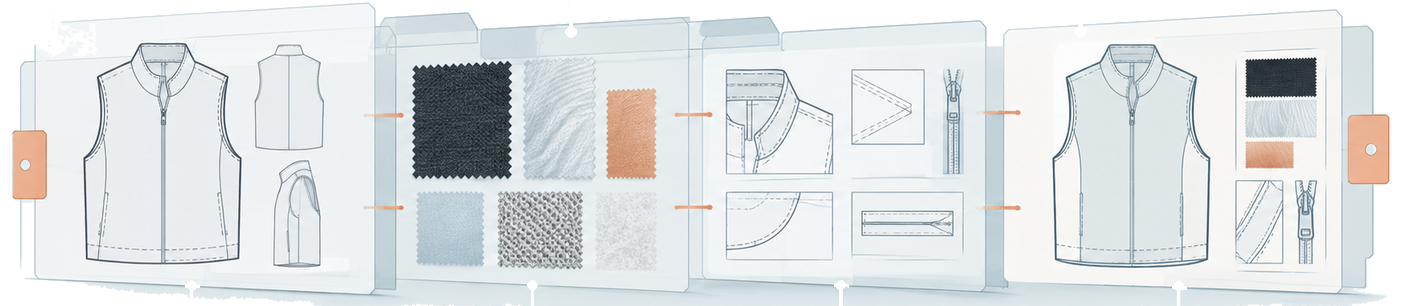

Fashion teams rarely lose time because creativity is lacking. They lose it when product data, supplier updates, production decisions, and inventory signals sit in separate systems. For designers, brands, and manufacturers, fashion industry digital transformation connects those decisions so the right people can act on a shared, current view of each product.
See how iCreate.Fashion can support your workflow. Talk with the team about iCreate Pro for designers and brands, or Core and Power for manufacturing operations.
Fashion industry digital transformation connects product, manufacturing, and inventory information across the garment ecosystem. This helps teams organize traceability and make better-informed operational decisions without treating software as a guarantee of compliance or sustainability outcomes.
The opportunity is broader than adopting another standalone tool. It is about building an operating model that can support evolving data expectations, including EU policy developments, while keeping practical ownership and decision-making clear. The foundation is a connected system that brings creative and operational information together.
The system behind fashion industry digital transformation
In the global apparel sector, fashion industry digital transformation is far more than a collection of isolated software tools or paperless office initiatives. At its core, it represents a system-level shift from fragmented, siloed workflows to a connected garment ecosystem. Historically, the fashion industry has struggled with disconnected handoffs, where design data is separated from physical manufacturing realities. Digital transformation addresses this challenge by building a unified framework where product specifications, design assets, and production instructions can move across the garment value chain.
This guide focuses on the operating model behind those connections, then points to narrower resources where implementation detail belongs.
From disconnected handoffs to a connected garment ecosystem
This system-level transformation fundamentally redefines the relationships and responsibilities across the entire garment supply chain. For designers and brands, it means moving away from static design files and establishing live, version-controlled tech packs that protect design integrity while remaining machine-readable. For suppliers, it offers real-time visibility into incoming material requirements, reducing supply-chain friction. Manufacturers and factory operators can leverage this digital link to align floor-level capacity directly with real brand demand, minimizing production bottlenecks and reducing material waste. Finally, retailers benefit from predictable inventory flows and verified product histories, which they can confidently share with consumers who demand greater transparency. By connecting these diverse stakeholders in a single digital loop, the industry can transition from isolated operations to a highly responsive, collaborative network.
Why product data and production data belong together
A successful digital transformation strategy requires product data, such as bills of materials and styling specifications, to be integrated with physical production workflows. When these systems are disconnected, brands can face communication delays, high sampling costs, and excess at-risk inventory.
By uniting product and manufacturing data, companies can make more informed production decisions and establish a foundation for regulatory readiness. A digital product passport is one specific application that depends on this central data system. Brands looking for implementation detail can consult the existing digital product passport guide for fashion brands.
For a broader view of how connected software supports this shift, explore the foundational fashion software article.
Why EU compliance is changing fashion data operations
EU sustainability policy is making product information an operational concern, not only a legal or reporting exercise. The European Commission identifies textile apparel as a priority product group in the Ecodesign for Sustainable Products Regulation (ESPR) 2025-2030 Working Plan for future ecodesign requirements and a Digital Product Passport (DPP). For brands, manufacturers, and suppliers, that direction makes the quality, ownership, and accessibility of product data increasingly important across the garment lifecycle.
The ESPR is Regulation (EU) 2024/1781, but the practical textile requirements are not fully specified yet. The European Commission states that textile-specific requirements will be established through a future delegated act, supported by technical specifications. The same source lists Q4 2027 as the planned adoption date for the textiles delegated act. That is a planning marker for legislative adoption, not a universal effective date or a binding deadline for every brand to have a completed passport. The Commission also notes that implementation timelines may evolve as legislative and technical work progresses.
This distinction matters when teams plan technology investments. Rather than building around an assumed final template, they can strengthen the underlying record that connects design, materials, suppliers, production, and inventory. A product lifecycle management (PLM) system can organize specifications and bills of materials (BOMs). While enterprise resource planning (ERP) and warehouse management (WMS) systems can help connect production and inventory records. The goal is not to claim compliance in advance. It is to make relevant information easier to locate, review, update, and share as the rules become more precise.
The Commission describes possible DPP information such as product identification, characteristics, fibre composition where relevant. Origin, and guidance for use, repair, maintenance, reuse, resale, and end-of-life handling in its textile apparel overview. It also indicates that DPP obligations will primarily concern economic operators placing textile apparel on the EU market or putting it into service there. Depending on the circumstances, those operators may include manufacturers, producers, or importers. Distributors and dealers may also need to ensure that a passport is available for products they distribute or sell.
For an introduction to passport concepts, use the detailed Digital Product Passport guide. Treat it as educational context, not legal advice. Specific obligations should be assessed against the final delegated act and qualified professional guidance.
What is a Digital Product Passport in fashion?
A Digital Product Passport (DPP) is structured product data connected to a physical garment through a data carrier, such as a QR code or electronic tag. The carrier links the item to a digital record that can make relevant information easier to access for businesses, consumers, repairers, recyclers, and other authorized stakeholders. It is not simply a campaign page or a standalone code. Its value depends on the quality, ownership, and reliability of the product information behind the link.
For a fashion product, that record may bring together identification and product characteristics, fibre composition where relevant, origin information, and evidence about materials or production. At an orientation level, it can also support information about use, repair, maintenance, reuse, resale, refurbishment, and end-of-life handling. These categories connect the garment’s design and production history with decisions made during use and after sale. The exact information requirements for textile products remain subject to future delegated acts and technical specifications. Businesses should therefore treat this as a planning framework rather than a binding checklist.
The European Commission describes textile DPP work in the context of the Ecodesign for Sustainable Products Regulation and notes that textile-specific requirements will be defined through a future delegated act. Its published planning information may change as legislative and technical work progresses. That makes a connected product record useful before any final rule is available, while legal obligations should be confirmed with qualified advisers.
For implementation detail, data governance, and questions about how a passport fits into a broader product workflow, see the digital product passport guide for fashion brands. The broader digital transformation challenge is to make the underlying product, supplier, and manufacturing data accurate and usable across the garment ecosystem.
Build the data foundation: traceability, materials, and evidence
Implementing a successful digital transformation strategy in fashion requires moving away from disconnected documents toward a unified data architecture. Before any brand can publish a digital passport, it must establish a structured, verifiable system of record. Every physical garment is the result of multiple lifecycle phases. And compiling the necessary documentation is primarily a data quality and collaboration challenge rather than a hardware selection problem. This data foundation requires mapping key assets to digital records that capture the reality of the production floor.
Map the product and its supply chain
To establish useful product transparency, companies must map the layers of their value chain. Peer-reviewed research indicates that monitoring social and environmental impacts across textile value chains is a foundation for product-level traceability. Digital traceability systems can collect data throughout the product lifecycle, helping operators use information across design, production, retail, and disposal decisions.
A European Parliament study on textile digital product passports also identifies the potential to improve traceability, circularity, and transparency across complex supply chains. These findings describe the value of connected records. They do not guarantee that every supplier or lifecycle event will be visible immediately.
Practical traceability is a gradual, collaborative process. Modern fashion supply chain transparency software can help bridge gaps by connecting high-level claims to product-level records, including material certifications, transaction documents, factory profiles, and production updates. That evidence-based approach is more useful than broad, unverified declarations.
Make claims auditable and useful
For traceability to be useful, data must be auditable and securely managed. Product specifications, bills of materials (BOM), supplier records, facility details, and sustainability evidence require strict versioning and clear ownership. When multiple partners update production data, static records quickly become outdated and unreliable. Implementing dedicated compliance management software for fashion allows brands to organize regulatory requirements, track and verify evidence, and manage supplier compliance efficiently across the entire product lifecycle. This centralized control ensures that any changes to product specifications are instantly propagated throughout the ecosystem.
Finally, data security is paramount when sharing intellectual property. While transparency is necessary to prove sustainability claims, sensitive factory data and proprietary designs must remain protected. Consequently, data access rights must be carefully managed in accordance with applicable EU legislation, ensuring that information is shared securely based on stakeholder roles and authorization levels. This layered access ensures brands can demonstrate compliance without compromising proprietary trade secrets.
When will DPP requirements affect fashion businesses?
Understanding the exact timeline for the EU Digital Product Passport (DPP) is essential for strategic planning, but fashion businesses must separate speculative dates from confirmed legal frameworks. The Ecodesign for Sustainable Products Regulation (ESPR) establishes the statutory foundation, but specific deadlines are not yet set in stone.
What is confirmed and what remains to be specified
The European Commission lists textiles on an indicative 2027 schedule for developing product-specific requirements. However, this 2027 date represents a development timeline for the Commission rather than a binding compliance deadline for brands. Under the ESPR, economic operators will receive a transition period of at least 18 months after the specific delegated acts for textiles are officially adopted.
Consequently, the earliest realistic compliance requirements are not expected to take effect until late 2029 or early 2030, depending on when these future acts are finalized. Product-specific requirements remain subject to future legislative acts, so businesses must monitor official EU updates.
Furthermore, any timelines referencing European Parliament research phases for 2027, 2030, and 2033 are part of a nonbinding policy research study, not enacted law. These dates represent potential deployment scenarios evaluated during research, not a mandatory compliance schedule.
Plan for change without guessing the deadline
A key aspect of planning is understanding how DPP data is stored and managed. The EU will maintain a central DPP Registry, but this database is designed only to store unique product identifiers and essential registration metadata. The full, detailed product information will be stored in a decentralized manner by the economic operators themselves or by authorized DPP service providers. This makes it prudent for brands to plan secure, standards-compliant product data repositories early, while monitoring the final requirements.
For official regulatory updates, refer to the European Commission DPP page and the published EUR-Lex ESPR text. Disclaimer: This article provides an educational overview of regulatory developments. It does not constitute legal advice, and businesses should consult qualified legal counsel to determine their specific compliance obligations.
Connect PLM, ERP, WMS, and factory workflows
Executing a successful fashion industry digital transformation requires uniting systems of record that have traditionally operated in silos. Product Lifecycle Management (PLM) platforms house design concepts, material specifications, and bills of materials. Enterprise Resource Planning (ERP) systems manage financial transactions, purchase orders, and resource planning.
Warehouse Management Systems (WMS) track raw materials and finished goods across distribution hubs. When these systems operate in isolation, valuable data gets trapped, leading to manual reentry and operational bottlenecks. Connecting product data across these layers gives teams a more consistent source of information and can reduce communication errors.
One product record across design and production
Establishing a seamless workflow across the product lifecycle begins with a reliable data foundation. Traditional flat sketches and static specification sheets can fail to sync with downstream factory floors, creating communication gaps, manufacturing errors, and material waste.
For independent designers and apparel brands, iCreate Pro helps organize, store, and communicate existing design assets, product information, and tech-pack details across collaborators. It supports structured product workflows and collaboration rather than replacing the creative design process. Teams can assemble and store smart tech packs that are readable by people and usable in downstream production workflows.
For a detailed guide to this essential product record, explore the tech pack fashion workflow resource. Establishing a consistent digital thread early helps brands protect creative assets while giving manufacturers actionable production instructions.
Modernize factories without breaking the operation
For garment manufacturers, adopting new digital systems often presents a risk of disrupting daily manual floor operations. To solve this, iCreate Core is designed to bridge the gap between garment manufacturers and professional designers globally. This solution provides a practical, non-disruptive modernization pathway, allowing factories to improve project visibility and coordinate directly with brands without interrupting their existing physical workflows. For larger, multi-facility operations seeking complete integration, iCreate Power supports next-generation factory operations by integrating PLM, Operating System (OS), WMS, ERP, and Rapid Response capabilities into a single, cohesive operating system. Unifying these enterprise tools ensures that floor-level manufacturing workflows align perfectly with real-time inventory levels, giving operators the agility to adjust production based on actual market demand.
Ready to connect your design, production, and factory workflows? Contact iCreate.Fashion today to learn how the connected workflow can fit your operation.
Move from forecast-heavy production to demand-aware decisions
Traditional apparel manufacturing relies heavily on speculative forecasting, producing high volumes of inventory before a single item is sold. This model often leads to excess stock, steep markdowns, and severe fabric waste. Digital transformation offers an alternative approach by shifting the operational focus from guesswork to responsive manufacturing.
Understanding the sell-one, make-one paradigm
A central concept in sustainable fashion production is the “sell-one, make-one” model. Rather than promising the complete elimination of fabric scraps or unsold stock across the industry, this model is best understood as an on-demand production paradigm.
In this framework, actual market demand triggers the manufacturing cycle instead of speculative projection. By moving from a “make-one, sell-one” structure to a demand-driven approach, businesses aim to align production schedules with live transaction data and lower the amount of at-risk inventory held in warehouses. This approach can support more responsive production, but it is not an automatic solution for every waste or efficiency challenge.
Reducing risk through integrated information flow
Transitioning to demand-driven manufacturing requires communication between departments and software tools. Connecting product specifications, order entries, shop-floor production updates, and warehouse stock levels is critical for informed decisions.
For instance, with modern apparel inventory management software, real-time stock levels can inform procurement and capacity allocation. Fashion supply chain management can also help synchronize material availability with live customer orders. When managers can access unified product and order records, they can decide what to produce, when to start a run, and where to allocate factory capacity. This integrated data flow can minimize bottlenecks and overproduction while helping teams respond to market shifts.
To see how this integrated approach can optimize your business, contact iCreate.Fashion to learn how the connected workflow could fit the operation.
How can fashion companies prepare for digital transformation now?
Preparation is more effective when it starts with the operating reality of one product line, rather than an attempt to replace every system at once. A practical framework makes ownership visible, exposes data gaps, and gives creative and factory teams a shared basis for deciding what to connect first.
- Assign accountable ownership. Name a cross-functional owner who can coordinate design, sourcing, manufacturing, inventory, compliance, and technology decisions. The owner does not need to control every activity, but should be able to define responsibilities, resolve conflicts, and maintain the transformation roadmap.
- Inventory the information you already hold. Map the records that describe a product, including the bill of materials, specifications, supplier and facility details, production updates, inventory movements, and available sustainability evidence. Record where each item lives, who maintains it, how often it changes, and which teams depend on it. A structured tech-pack workflow can help establish a consistent product record from design through production.
- Assess gaps and data quality. Compare current records with the information your teams need for traceability, product decisions, and applicable regulatory work. Look for duplicate identifiers, missing versions, unclear approvals, inconsistent material names, and evidence that cannot be linked to a specific product or supplier. Keep legal interpretation with qualified advisers. Technology can organize evidence, but it cannot guarantee compliance.
- Pilot one representative product. Choose a product that reflects real collaboration between design, suppliers, and manufacturing. Follow its data from initial specifications to production and inventory, documenting each handoff and exception. A focused pilot shows which integrations, permissions, and workflows are useful before the model is extended across collections or facilities.
- Review adoption and improve the record. Measure whether teams can find the current version, update it without creating conflicting copies, and explain who approved important changes. Use the review to refine naming conventions, access rights, training, and governance. Repeat the cycle as requirements and operating needs develop.
Scroll horizontally to read the full table.
| Stage. | Evidence to collect. | Operating value. |
|---|---|---|
| Ownership. | Named roles, decision rights, and escalation paths. | Clear accountability across product and production work. |
| Data inventory. | Product records, BOMs, supplier files, facility details, and versions. | Visibility into duplication, gaps, and disconnected handoffs. |
| Gap assessment. | Missing fields, approval history, source documents, and data-quality issues. | Prioritized improvements instead of broad, unfocused system change. |
| Pilot. | One product’s specifications, production events, and inventory links. | Evidence of which workflow and integration changes work in practice. |
| Review. | Usage feedback, correction patterns, and record-update history. | Continuous improvement in adoption, governance, and data reliability. |
This staged approach also helps teams choose technology according to their role. Designers and brands may begin with connected product workflows, while manufacturers and factory operators may prioritize collaboration, production visibility, or integrated PLM, OS, WMS, and ERP capabilities. The goal is not to digitize isolated documents. It is to create a dependable thread from product intent to operational evidence, then expand it carefully.
Ready to connect product, production, and inventory workflows? Contact iCreate.Fashion to discuss the right next step for your team.
Frequently asked questions about fashion digital transformation
What is fashion industry digital transformation?
At a system level, fashion industry digital transformation integrates digital technology across the garment lifecycle, moving the industry from manual handoffs to a connected global ecosystem. Rather than isolated tools, it connects design, product and manufacturing information, workflows, and inventory decisions on a cloud-based platform. This connects brands, suppliers, manufacturers, and retailers, enabling real-time collaboration with shared data instead of static spreadsheets.
What is a DPP?
A Digital Product Passport (DPP) is a digital container for products, components, and materials that stores data supporting sustainability, circularity, and legal compliance. It helps businesses, consumers, repairers, recyclers, and authorities access reliable, standardized product information. A digital data carrier, such as a QR code, links the physical garment to its DPP, enabling instant access to verified lifecycle records.
When will DPP requirements affect fashion?
The European Commission lists Q4 2027 as a planned adoption date for the ESPR textiles delegated act, not a universal effective date for every fashion business. Textile-specific requirements and implementation timing may evolve as legislative and technical work progresses. Businesses should monitor the official EU materials and assess their own obligations with qualified advisers rather than plan around an assumed fixed deadline.
Is all DPP data stored centrally?
No, storage is decentralized. Complete product data is maintained by the economic operator or their DPP service provider. The central EU database, known as the DPP Registry, only stores unique product identifiers and required registration metadata. This decentralized structure can help brands retain control over detailed product files while supporting standardized regulatory access.
How do PLM/ERP/WMS work together?
In a connected ecosystem, PLM houses design specifications, ERP manages business transactions, and WMS tracks inventory. Integrating these systems can create a continuous data flow and reduce avoidable reentry. For example, the iCreate Power enterprise platform supports factory operations across PLM, OS, WMS, ERP, and Rapid Response capabilities. Helping teams connect design changes with production orders and material inventory when those workflows are configured to work together.
How can software help reduce inventory waste?
Software reduces waste by improving data transparency and matching production with demand. Instead of forecast-heavy manufacturing that generates excess inventory, software can enable an on-demand, software-driven “sell one, make one” production model. Connecting sales data with factory-floor scheduling lets brands and factories coordinate production in real time, reducing overproduction without promising instant zero-waste results.
Where should a small or mid-sized apparel company start?
A small or mid-sized apparel brand should start by auditing current data to find gaps. Research shows monitoring environmental and social impacts along the value chain provides a baseline for digital traceability. Compiling specifications across lifecycle phases helps optimize design, production, and disposal decisions. Instead of massive systems, brands should pilot digital workflows with a single product line to build adoption.
Conclusion: Make compliance readiness part of the operating model
Aligning digital product data with sustainable production is no longer just an administrative task; it is the fundamental core of modern garment manufacturing. Establishing clear digital traceability connects creative design decisions directly to factory inventory levels and regulatory readiness. This integrated approach transforms compliance from a costly legal hurdle into a competitive, long-term operational advantage.
Start with connected information
To navigate upcoming environmental regulations, global fashion brands and manufacturers must prepare now. While early planning is essential, businesses should always verify product-specific EU requirements as they are adopted. Transitioning from fragmented spreadsheets to a unified SaaS platform that connects the garment ecosystem is the first step toward securing verifiable traceability across the product lifecycle.
Choose the next practical workflow
Connecting your ecosystem does not require disrupting your entire manual operation at once. Apparel designers and brands can build structured product records with iCreate Pro. Manufacturers can bridge collaboration gaps and improve project visibility with iCreate Core. For complete factory modernization, iCreate Power integrates workflows across PLM, ERP, and WMS. Explore these options and contact iCreate.Fashion today to evaluate how these connected workflows fit your business.
Get started with a connected fashion workflow
Fashion industry digital transformation is easier to evaluate when your next step reflects your role, data needs, and production priorities. Designers and brands can explore how iCreate Pro supports product workflows, while manufacturers and factory teams can discuss iCreate Core or Power with the team. To compare a practical path for your organization, contact us and share the workflow you want to connect.